ADRIATIC
ADVENTURE
A 35-day trip
with the marvellous Grassroots Travel group, plus independent bits
Singapore Layover Day (Thursday 27 August 2015)
The first leg of my trip did not get off to a very
auspicious start when I had to do the hissy fit effort at Auckland Airport to
get the Air NZ ground person to tag my luggage straight through to Athens
without my having to collect it in Singapore, store it, then check it in again.
Despite her telling me about six times that it was impossible, when I said
seven times that it WAS, she went off and consulted other personages to
discover that, Hey Presto! It can be done! I had vowed that on this trip I was
going to be sweetness and light to all concerned, (see previous trip blogs
about me and fire escapes and life jackets....) but when sweetness does not
achieve the desired results, bloody-mindedness can work.
So here I am in Singapore, luggageless, and wandering the
streets for a 16-hour layover. Well, of course I did not manage to walk for
more than six hours after the delights of "sleeping" all night in an
Economy seat, but I did cover a lot of ground. The modern architecture of
Singapore is amazing
 |
| Singapore Concert Hall |
 |
| Marina Bay Sands Hotel |
 |
| Singapore Science Museum |
and the Marina Bay Shopping
Centre is mind-boggling. All the shopping centres in Auckland would fit into
one wing of it. Fortunately I was there at 10am when the shops were still
closed, so I could not be tempted by the Gucci, Dior, Chanel and Hermes
offerings, though the lowest level did have Banana Republic and Gap and a few
others vaguely in my price range. Window shopping is best at this stage,
though, as I just have to think about lugging purchases up gazillion hotel and
train station stairs to dampen my enthusiasm.
 |
| Marina Bay Shopping Centre |
 |
| Waterfall swirls around the roof saucer before pouring down. |
Singapore does not seem very "Asian" in some
places, then you turn a corner and find street stalls selling indeterminate
fried objects that nevertheless smell delicious. However I confess to walking
out of the first restaurant I tried for lunch as it seemed to specialise in
pigs' intestines and mutton stomachs, (at least that is what the translations
said) and after a rather sleepless night my own stomach could not quite manage
that. Another street stall gave me a delicious noodles, pork and greens bowl
for $4, so that was more successful.
Off to the airport now to do
battle with another night flight - next news from Athens!
The Many Faces of Greece (Friday
28 August, 2015)
Overnight from
Singapore to Zurich on yet another crammed flight, then zigzagging back to
Athens, due to the vagaries of airline routes, brings me to sweltering Athens.
Super-budget-me busses successfully into town, gloating over my
parsimoniousness, (saved 35 euro -yayyy - more to spend on shopping or wine or
raki or anything!) and locates my tiny hotel midway between Syntagma and Monostiraki
Squares - soooo central! Cheery Greek fellow loads my bag and me into
microscopic lift to the fourth floor, then my room key opens up delightful
sparkling white room with drawn curtains. Opening up these curtains reveals A
SPECTACULAR VIEW OF THE ACROPOLIS!
 |
| Taken from my hotel room balcony, as seen from lying in bed. |
I can literally
sit on my bed and stare at the walls and the Parthenon! Wow! Not what I had
expected! So the mantra of "exceeding the costumer's
expectations" has been well and truly fulfilled here! Even such
fabulosity could not prop the eyelids up for long, however, so at heaven knows
what time on my body clock, I collapsed for 14 hours of delicious horizontal
sleep!
This morning, the Acropolis is
still there as I savour my brewed-in-my-own-little-travel-kettle coffee on my
teeny-tiny balcony, and plan a VERY leisurely day of maybe an old ruin or
two.
So
my first day
or two have given me a teensy insight into the many faces of Greece, August
2015. The ancient glories are still there, the ever-present scaffolding seems
to have come off most of the Acropolis, the soldiers in fancy dress still
prance in front of the government buildings every hour,
 |
| Must get those tassells in the right place! |
and the sun shines
never-endingly on cafes with cold beer and raki on offer. But it does pay to
look a little bit below this surface, a surface that Greece is desperate to
keep in place for the happiness of tourists who are perhaps its only ticket out
of the mess. My tour group will be part of this, so I can feel very virtuous
about every euro I spend!
Since the Acropolis will be part
of the formal tour starting in a couple of days, I have been spending my
jet-lag-overcoming two intro days in quietly wandering the streets and catching
a couple of extra museums. I am getting a full Acropolis dose anyway just lying
snoozily in bed! Wandering the streets means coming on groups of soldiers in
random places, doing ominous things like checking their smartphones for their
latest Facebook updates! Banners and posters in indecipherable Greek are
everywhere, but I can only imagine what they are saying, so that is not much
guidance.
The area around Syntagma
Square where the government buildings are seems quiet so far, but the area
behind was crawling with uniformed persons plus a few news camera vans,
apparently related to the recent resignation of the Prime Minister and the
appointment of an interim one, the first woman Prime Minister in Greek history.
Ironically it made me feel very safe meandering through the parallel wooded
lanes of the National Garden, as 10m away through the greenery were so many
soldiers that my squawks if I were accosted would probably have brought forth
enough firepower to generate some lurid headlines. But again, the soldiers were
just milling around looking bored, and sneaking looks at those cellphones
again.
Where the cracks begin to show is
in the economy of everyday life. The main tourist areas are lively, with shops
seemingly doing business from travellers, but it is the local operations that
seem to be suffering. I was trying to do my "get off the tourist
trail" thing, so, following advice from a six-year-old Fodor's Guide, I headed
past the hip tourist bars full of bright young tourist things chattering
loudly, with tables covered in food and drinks, to a taverna down a side street
which Fodor assured me was a lively spot popular with locals and serving
authentic, well-priced Greek food. Well, they are right about the food, as the
lamb was drop-off-the-bone tender, and the roast potatoes were very herby, but
the price was similar to what I would pay in Auckland, and clearly, almost no
locals can now afford it. On a Friday night, the place was about one-third
full, and judging by the languages spoken, only one table contained any locals.
Staff stand hopefully around, but few diners appear. Strolling back into the
tourist zone was like entering a parallel universe of affluence. So we shall
see if this is enough to turn things around.
Ignoring these realities, I
enjoyed a beautiful museum yesterday, the Benaki. I must confess that ancient
pots and flint axe-heads hold limited appeal for me, despite their obvious
usefulness if I had lived some thousands of years ago, so those parts of a
museum get a quick drive-through from me. What was stunning about this museum's
collection was the gorgeous display of Byzantine religious icon art. Just
amazing! So I feasted on lots of gold leaf and somber Madonnas with totally
unrealistic Christ-child miniature persons sitting perched on their hands!
 |
| Byzantine Madonna and Child icon |
 |
| And again....... |
 |
| Reception room ceiling of a mid-18th century Macedonian mansion |
Really! What thousand-year-old art teacher told them that perspective was
correct! Never mind, all very beautiful. Today will be the National Archaeological
Museum, so I am hoping this has some good statuary and is not too heavy on the
pots and axe-heads angle. This evening the tour group arrives, so to be
continued..........
Ancient Greece in a Museum, on
a Hilltop, and in Another Museum (Sat-Sun 29-30 August, 2015)
Saturday Morning
I set off to walk to the National Archaeological Museum, by way of the Central
City Markets and a few squares along the way. The tourist hub from Syntagma to
Monostiraki is bright and buzzing, with little signs of any economic distress,
but heading on to Omonia things become rather grimier with masses of ugly
graffiti giving a rather threatening atmosphere - and not like the arty
graffiti of Berlin or Lisbon. The museum was everything it should be, with
wonderful bronze and marble statues,
 |
| Artemision Jockey ca 100AD |
 |
| Aphrodite ca 100BC |
 |
| Zeus or Poseidon ca 460BC |
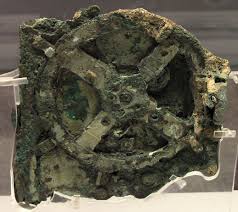
and the amazing Antikythera Mechanism
salvaged from an Ancient Greek ship of that name in 1901. Google it -
fascinating!
Sunday, with all the tour group here,
 |
| John, Brian, Graham, Geoff, Cherry, Adrienne, Karen, Tom, Jill, Josephine, Fong, Val, Annette, Cathy, Johnstone |
was attack-the-Acropolis day, so we duly
clambered up the hill early to try to beat a bit of the heat, and were regaled
with a few thousand years of Greek history by our earnest local tour guide. I
got lost about Pericles, who actually built most of it about 450BC, surfacing
briefly for mention of the Venetians blowing up the Turks' munitions store
inside it, and then there was the evil / very clever Lord Elgin who spirited
large chunks off to Britain, these now jealously guarded by the British Museum.
 |
| View from rooftop of my hotel |
It is a wonderful place to visit, but probably the best concept of it is gained
from a distance, such as the vantage spot on the roof of our hotel, where its
imposing position on the hilltop adds grandeur, and you cannot see the
disfiguring repair scaffolding, or the swarms of tourists.
The New Acropolis Museum was our next port of call to see the items from the
Acropolis now stored safely away from the depredations of pollution or any more
Lord Elgins. The museum hopes fervently for the return of what they see as
stolen treasure, from any number of museums and collectors around the world,
but that is a very fraught issue, so I do not imagine the gaps left for the
return of these items will be filled any time soon.
 |
| Parthenon Model |
 |
| Model of characters from the west pediment of the parthenon |
Tomorrow is Corinth and Delphi - more adventures.......
Ancient Corinth, Corinth Canal
and Acrocorinth (Monday 31 August, 2015)
Yes, you guessed
it, we loaded the wagons and headed from Athens to various versions of Corinth.
It appears that despite all of St Paul's efforts in those assorted Letters to
the Corinthians, they were a fairly dissolute lot. Never mind, they built an
astonishing fort at Acrocorinth.
But back to the beginning - first
stop was the Corinth Canal, which Ancient Greeks and Romans wanted to build,
but failed. Nero even set 6000 Jewish slaves to work on it, but to no avail.
French engineers finished it at the end of the 19th century, joining the two
seas whose names I shall get later from Google! (Aegean and Ionian?) It looks
very steep and deep but apparently is actually now too small for most
commercial shipping.
There is a very ingenious sunken bridge in the middle to
allow shipping to cross, rather than a raised and opening version a la Sydney's
Spit Bridge.
From the canal we travelled via the ruins of Ancient Corinth - lots of jumbled
rocks, and only the outline of structures – then up the road to the top of an
enormous hunk of a rocky mountain.
 |
| The mountain of Acrocrinth (acro = high) |
This is Acrocorinth, or "high
Corinth", the mountaintop refuge to which the Corinthians withdrew when
under attack. Incredible how they managed to build this extensive protected
town perched atop this inaccessible rock. There was interesting walking, but VERY hot in
the midday sun as we scrambled along marble cobblestones up steep paths.
Amazing views out across the plains, and obviously a very secure fortress
against attack.
Off to Delphi tomorrow........
Delphi and Meteora (Tuesday 1
September, 2015)
On from Corinth, we drove up and
over many hills, some of which are ski resorts in the winter, to the town of
Delphi, above which is the ancient site of the Oracle of Delphi. In Ancient
Greek times, a fissure in the rocks leaked an assortment of gases which sent
the Oracle (different women over hundreds of years) into a trance, during which
she mumbled incoherently. A priest then translated this into the prophecies
which apparently were revelations directly from the gods. Hmmmmmm - quite a
powerful job, being that translator! Anyway, many temples and treasure houses
were built around the Oracle's little room, and it was one of the major sites
and sights of Ancient Greece.
 |
| Model of the Delphi Oracle's Temple complex |
There is a marvellous museum
below the site where amazingly intact statues and other relics are displayed
which have been excavated from the ruins.
 |
| Add caption |
It is not on quite the same scale as
the Parthenon and Acropolis, but is still fantastic. It was also believed to be the centre of
the Earth, so a large decorated stone marked the "navel" spot.
We then clambered over the
ruins, above the room of the Oracle buried deep inside the temple,and up to a
great amphitheatre with excellent acoustics.
During the afternoon we then
drove on to Meteora, through many hills again, until in the distance we began
to see the great rocky mountain hulks that contain the Meteora monasteries. As
we grew closer they just got bigger and bigger, into some amazing slabs of
solid sheer rock faces. Our hotel was directly beneath one which resembles El
Capitan in Yosemite, and other enormous crags surround the town, with a few of
the monasteries on top visible from ground level, with many others scattered
around in various mind-blowingly inaccessible spots.
 |
| Meteora mountain slab above our hotel |
 |
| Toppling, toppling....... |
 |
| View from the supermarket carpark - amazing! |
I had read of the
monasteries on the mountains, but I had no concept of the scale of the
mountains or how truly inaccessible they must have been in the days of rope
ladders, baskets and nets. No wonder the Ottomans left them to it!
The first evening we drove around
a recently created road that leads up the eastern side of one of the mountains
to get a view of a couple of the monasteries which now have carved tracks -
imagining these being built in the days of hauling rock up by hand is amazing!
 |
| Meteora Agios Stefanos - the only convent in Meteora |
Some
of the crags are floodlit at night, so dinner in Kalambaka beneath these, at an
open air restaurant is quite magical.
Meteora (Wednesday 2 September, 2015)
Early the next morning we were
off up another mountain road on the western side to Megalometeora, or Grand
Meteora, the Monastery of the Transfiguration. There is now a pathway for
access to the monastery, but you still get the feeling of how remote this must
have been in the days when ropes and ladders were the only way in.
 |
| Megalometeora |
 |
| Megalometeora Icon of Christ |
 |
| Chapel exterior |
We had an
excellent guide who gave us explanations of the monastery’s history and
architecture as it connected to the Greek Orthodox faith, and it was a truly
wonderful place, with a most beautiful chapel, fully decorated with biblical
and other scenes. The entrance section of the chapel in particular was painted
with every variety of gruesome martyrdom as a lesson to the faithful! It used
to be the base for a community of up to 300 monks, some of whom lived down on
the flat lands, growing food for the monastery, then once or twice a week,
carrying it up to the mountaintop. This was definitely some dedication in the
days before access roads and paved pathways!
 |
| Postcard of various monasteries and means of approach in past years |
 |
| Mountains on the approach road to Megalometeora |
Meteora is one of the places
which has hugely exceeded my expectations, a reminder that simply seeing the
photos, or reading the guidebook description, cannot give you the true
experience.
Off to the Vikos Gorge..........
Monodendri
and the Vikos Gorge (Thursday 3 September, 2015)
Meteora would
have benefited from a longer stay, to visit a few more monasteries, but we were
on the road again, heading for the Vikos Gorge, another of those places that
claims Guinness Book of Records status as the biggest something. We are now in
the north west of Greece, in the Pindus Mountains. The Vikos Gorge is in the
southern slopes of Mount Tymfi, 20km long, with a depth ranging from 450 to
1600m, and a width of from 400m to only a few metres in some places. The GBR
bit, is that it claims to be the deepest gorge in the world, which as
apparently disputed because of the way a gorge is defined rather arbitrarily on
some width:depth ratio thing, but never mind, it is still amazing.
 |
| Vikos Gorge |
 |
| Vikos again |
The super-fit members of our group
are doing a six-hour hike into the gorge this morning, but I am taking the
lesser option of a shorter walk in at the other end to meet them, while still
hopefully getting a good view of the gorge itself. The pool at the hotel, and a
lazy morning to do things like catch up on blogs and emails is rather appealing
after our fairly hectic schedule so far.
We meandered around the rim of the gorge in our bus, taking in viewing vantage
points into the gorge, and a Stone Forest of interesting rocks.
 |
| Amazing rock formations |
 |
| Slab rock strata |
 |
| A few S-bends there ...... |
Three of us
then met the walkers coming out of the canyon, fifteen minutes down the
mountain track, presenting them with fresh cold water, then walked back the
last section, so I can at least say I did hike the Vikos Gorge, even if only in
a very minor way. The scenery is fantastic, and leaning over the viewing spots
down into the gorge is very vertigo-inducing. Quite an amazing place, and I am
happy to let them have their claim to GBR fame as the deepest gorge, as it
certainly looks that way from our rock perches above. The hotel swimming pool
was a most fabulous cool-off after a grey hot day.
Off to Albania this morning as the adventure continues
Into Albania (Friday 4
September,2015)
Off from
Monodendri, we drove north towards the border with Albania. Large queues of
trucks loaded with everything, including one with the products of some
inorganic rubbish collection literally including the kitchen sink, which was
being unloaded for inspection in case there was a random refugee or two hiding
inside the debris. We have not seen any evidence in this area of the refugee
crisis affecting other parts of Europe, but perhaps when we reach the Dalmatian
coast.
Entering Albania, we noted the
large Pepsi sign showing that the West has reached here with all important
things. On through the countryside, things looked more fertile than what we had
left behind in Greece, but the production methods that we saw were at the level
of the hand-stacking of hay, and several men loading rough bundles onto
carts. Donkeys seem popular still, though there are some modern farm vehicles
too. The tourist town of Gjirokaster with an attractive fortified castle seemed
quite buzzing, though the power being off did slow things down a bit in cafes,
and the castle was somewhat dark and gloomy without lighting, however
since all the inscriptions were in Albanian this probably did not slow down our
reading too much.
 |
| Gjirokaster Castle |
 |
| Castle interior with some ancient gunnery |
 |
| Inscription in Albanian, but he appears to be a WW2 soldier - significance?? |
We wandered the cobbled streets, stopping for a streetside lunch of a local pie,
then headed off to Berati.
The road along the way showed some massive spending on infrastructure, but also
many abandoned or unfinished houses and commercial buildings. There seems to be
a lot of rubble mounded into random heaps.
The "mushrooms" are
also an interesting sight. These were the brainchild of the crazy Communist
despot, Enver Hoxha, who wanted these spherical concrete bunkers sunk all over
the country as refuges for the people against some unknown Armageddon, all very
impractical, and now hugely difficult to remove. Some are turned into storage
cellars, some become places of illicit assignations, and some get covered with
dirt and planted over. They were literally blast-proof, as the fellow who
developed them had to prove their functionality to Hoxha by sitting inside one
while it was bombarded with shells! He and it survived! Apparently a method of
removal has finally been developed so they are slowly disappearing.
 |
| Mushroom to the left, shot from passing bus window! |
 |
| Mushroom in Tirane park, one of the ones near Hoxha's palace - you can go down inside, but claustrophobia detered me. |
Berat,
the Town of a Thousand Windows (Friday-Saturday 4-5 September, 2015)
During the
Ottoman era, the houses in this town all used identical arched windows, giving
an unusual effect when viewed from below. We
arrived at a massive fancy new hotel on the outskirts of town - it was
apparently previously a cotton mill, but has now been flossied up to house
tourists, hopefully calling itself four star. It is quite grand in some
respects, but still very Eastern European in others. Our room was spacious but
quite sparsely furnished, and the bathroom offered one bottle of hotel shampoo,
rather than the usual range of little delights in Western hotels. The evening
meal and breakfast however were excellent, including a charming young violinist
entertaining us at dinner.

We were bussed into town for the evening stroll
along the newly constructed esplanade where the whole male population of the
town appeared to be perched in front of TV screens playing the Albania-Denmark
soccer game which ground to a 0-0 draw to the sound track of much shouting,
booing, sighing and clapping. Very few females in evidence, so they must have
all been all tucked up safely at home, I imagine. The houses on the hillside showed the origins of the name of "the town of a thousand windows"
 |
| Berat hillside at night |
It then became clear why we were
ensconced in this new hotel outside of town. The hotel that Grassroots had
previously used in the centre of town, on the riverbank, had been blown up!
Apparently it had been built illegally during the Communist years in a prime
spot right beside the main bridge over the river, so despite the current owner
having just spent a large amount of money renovating and upgrading it, the
current government decreed it illegal, so it was literally blown up, with all
the townsfolk watching, and minimal compensation to its owners! Does not pay to
be on the wrong side of alliances, does it!
The next morning we visited the
VERY local market, with cages of rabbits, rows of leg-tied chickens, ducks and
turkeys, loaves of tobacco and many other delights.
 |
| Cigarette anyone? |
 |
| Poultry is certainly fresh. |
The people were mostly
friendly, but from some of the older people there was a rather hostile vibe, so
I was glad to stick close to our group members, and was careful to photograph
surreptitiously at times.
 |
| Traditional hats now not so commonly seen. |
Next was a visit to an old Ottoman house to see how
the aristocrats of that era lived, with little hidden galleries for womenfolk
to observe visitors, and beautiful timber and stone furnishings.
 |
| Berat Ottoman merchant's timber house |
Then it was on
the bus to Tirane for more of this very strange country.
Tirane (Saturday-Sunday 5-6
September, 2015)
We arrived in
Tirane along streets with the usual mixture of fancy new developments and very
shabby Communist-era apartment blocks with flaking plaster and moth-eaten
paintwork. Our hotel is in one of the better areas of town, with nearby
embassies, but still a lot of rubble piles and abandoned buildings. Some of
these however are marked for demolition and redevelopment, so there are
positive signs. The streets are generally clean, and individuals seem to try to
keep their environment tidy as well, with much mopping and sweeping going on.
Sunday
We did a guided walking tour this
morning with a very informative young Albanian man
who gave us an intensive
crash course in Albanian history which has been through enormous ups and down
over many centuries and particularly in the years since the Second World War.
 |
| Section of the Berlin Wall |
 |
| Monument to those killed by repressive Hoxha regime |
I
knew of the repressive regime of Enver Hoxha who followed a particularly rigid
and harsh form of Communism but I was not aware of all the ghastly specifics.
Then there was the period of horrible instability when the regime collapsed in
the late 90s - one of the last Communist states to fall. The people were
totally naive about economic realities, and imagined that once Communism
disappeared, that by some magical process they would all start to live the
lifestyles they had seen on newly available Italian TV, and even like some of
the American TV they had seen such as Dynasty! Much confusion ensued when this
did not happen. Then up popped a marvellous money-making scheme (think
"pyramid scheme", my friends) into which large numbers of the
population were sucked, selling their few possessions to invest, until the
critical mass of collapse was reached, and the whole country descended into
chaos in 1997! The economy fell over completely.
Since then, things have been
slowly recovering, and they hope to perhaps enter the EU in 5 years. The museum
we visited was a fascinating trip through the years of chaos, invasion,
despotism and hopefully recovery.
 |
| Tirane Museum mural of Albanian fighters successful from Illyrian times to World War 2 |
We then went to visit the three
religions of Albania, all with important sites in the centre of Tirane, all
newly rebuilt after their destruction by Hoxha.
 |
| Interior of Tirane mosque |
 |
| Tirane Eastern Orthodox church |
 |
| Mother Teresa |
|
|
 |
| The interior of the Tirane Catholic church, featuring Mother Teresa, though not named after her! |
The much-beloved Mother Teresa
helped with the rebuilding of all of these, regardless of the denomination,
more reason for the people to revere her more than any other Albanian.
A couple of hours north of Tirane, in a small provincial town, we stopped for morning coffee at a bizarre restaurant (across the road from its bizarre twin edifice). One imagines they must be built from ex-pat money sent home to the family, and would win any bad-taste architectural award as tied-for-first clear winners by an ALbanian country mile. Very strange indeed.
 |
| The restaurant we stopped at |
 |
| The opposition across the road |
 |
| Delightful architectural touches |
 |
| The establishment next door....... |
 |
Group fortified with coffee
|
Over the Border into "Yugoslavia"
For next couple of weeks we will be in three countries of the old "Yugoslavia", so here is a VERY brief summary of where these countries fit into the history of the last century.:
VERY BRIEF “YUGOSLAV”
HISTORY
·
Austro-Hungarian Empire redrawn after 1918.
·
The “Kingdom of Yugoslavia” formed from 1918 became
the six republics of Bosnia and Herzegovina, Croatia, Macedonia, Montenegro,
Serbia and Slovenia, and two semi-autonomous provinces of Kosovo and Vojvodina.
·
In 1941, the Axis powers invaded, and the royal
family (regent and under-age King) fled to London.
·
In Nov 1944, the Allies recognised the
government led by Tito and his partisans.
·
Tito held the disparate cultures, ethnicities
and religions of Yugoslavia together until his death in 1980, but after his
death a power vacuum resulted in a resurgence of the old rivalries.
·
Break-up of “Yugoslavia”:
·
1991:
Secession of Macedonia (peaceful)
·
1991:
Secession of Slovenia (10-day war)
·
1991-1995:
Croatian War of Independence,
including the 1991 Siege of Dubrovnik
·
1992-1995:
Bosnian War, including the siege of
Mostar 1992-1994, and Siege of
Sarajevo, (Capital of B-H) the longest
siege of a capital city in
the history of modern warfare, first by the
Yugoslav People's Army, then the
Bosnian-Serb Army from 5 April 1992 to 29
February 1996 (1,425 days)
·
1998-1999:
Kosovo War
·
Insurgencies in Presevo Valley (1999-2001) and
Macedonia(2001)
Current countries:
·
Croatia
·
Slovenia
·
Bosnia-Herzegovina
·
Macedonia
·
Montenegro.
·
Serbia (including the provinces
of Kosovo and Vojvodina)
Montenegro (Monday 7
September, 2015)
This is a tiny
country in the lower western corner of the former Yugoslavia, and was the last
to gain its independence from Serbia - Kosovo wants to be independent but
Serbia will still not agree. Historically it used the magnificent harbour of
the bay of Kotor
 |
| Bay of Kotor |
as a powerful bargaining tool with Ottomans and Venetians to
often stay out of trouble, but was still a bridge of invasion north and south.
More recently it was allied with Bosnia in the Yugoslav civil war to invade
Dubrovnik at the beginning of the 1990s. So a typical Balkan sort of history.
We drove up across the border from Albania (more "tips" to the border personnel, as there had been on entering Albania from Greece, handled by our bus driver very competently!!) up the beautiful Montenegrin coast
 |
| Sveti Stefan - maximum land usage?? |
to Kotor to see the beautiful fjord, and the lovely old town
with the usual fortress on top of the hill.
 |
| Fortress overlooking Kotor |
 |
| Kotor Town |
Half our group steamed all the way
to the top of the mountain, but I took the half way option, then retired to the
town square for a gelato. The view of the fjord from the upper hillside is as
gorgeous as the guidebooks say.
We then drove back to Budva, a
nearby seaside resort
 |
| Statue on coastal walk in Budva |
 |
| Rock formations on coastal walk |
for the evening, and a lovely dinner at a restaurant on
the sands of the beach. The prevailing impression is of the number of Russians
around, and apparently it is even more pervasive than can be seen on the
surface, as there has been a major buy-up of land and buildings by wealthy
Russians of often dubious provenance, and now many businesses and hotels are
Russian-owned and not contributing much to the local economy. These Russians
saw a country newly emerging from a communist economy, with a lovely coastline,
and took maximum advantage. The same has happened in Croatia to a lesser
degree, as after the civil war the locals often could not afford to rebuild
hotels so they were sold to Russians at bargain basement prices. So the lovely
blue seas and skies of the Adriatic are accompanied by much darker issues.
In the morning we did a walking
tour of the Old Town of Budva, with lovely winding alleys and very
Venice-looking architecture. Then onto a different mini bus for our journey to
Dubrovnik
To Dubrovnik (Tuesday 8 September,
2015)
We drove up the coast from
Budva, around the Bay of Kotor, and onto a ferry across part of the bay to head
for the border with Croatia. Our driver was born in Mostar in Herzegovina, but came to Dubrovnik as a child for his education
and stayed on to live, visiting his parents and grandmother back in Bosnia
Herzegovina on weekends. So for
the three hour drive we were regaled with a very interesting version of the
history of this very complicated area. Later, in Mostar, the significance of this became clear. He would have
been part of the Croat community in BH who live mainly in the west of the
country and in West Mostar; as we learned later, these Croats then became the
enemy during the civil war in BH, as they were the ones who laid siege to
Mostar and shelled the bridge. He was perhaps sent to Dubrovnik for education
as a Croat, and hence preferred to stay on there after the war as tensions
there are still a bit raw.
He clearly loved
Dubrovnik and Croatia, but was rather despairing of the corruption and the
complete shambles of bureaucracy and mismanagement of the country. This seems
to be a recurring theme! We drove through the countryside that was the scene of
the invasion of lower Croatia by Bosnia and Montenegro as they tried to take
Dubrovnik. We saw the nearby town where the electricity for Dubrovnik is
generated and which was captured by the invaders so that for the years of the
siege the city was often without power, ditto the water supply. The story of
the siege is quite amazing, as the invaders imagined that the locals would
immediately capitulate, but they dug in and defended their city, with amateurs
suddenly becoming soldiers and fighters, many losing their lives in the ensuing
long-drawn-out battles. Later, seeing the beauty of the city this seems an impossible past to imagine, but it
is very raw in the minds of many.
Anyway, we arrived in Dubrovnik
in the evening, staying in an area called Lapad which is a modern, rather
affluent part of town to the north of the Old Town. There are lovely
restaurants along a coastal walk with beautiful sunset views.
We wandered this
area, enjoying the sunset, then off to bed to prepare for a VERY big day.
Dubrovnik
(Wednesday 9 September)
We then had five (I only stuck it
for three!) hours of intense personal sharing from a lifelong Dubrovnik
gentleman who lived through the relatively recent siege by the
Serbian-Montenegrin forces who imagined Dubrovnik would cave immediately. Instead
there was a several-year battle of attrition for control of the city with many,
many locals and other Croat troops dying in the process. Our guide, one of the
men who used to climb the hills at night to attack the Serb postions, saw at
close quarters the Serb soldiers behead his friend, then play football with the
severed head! How does one survive that? I am not sure I could, but here in the
Balkans history is rather nastily repetitive. The physical damage is being
repaired very well in many places, but there are still ruins to remind us of
the sad destruction of buildings and people.
 |
| View from the walls across the city |
 |
| City view |
 |
| The fortress, viewed from the walls |
 |
| Shelling damage, under repair |
 |
| Drawbridge into the town |
The heat on the walls after the
morning of kayaking rather did me in, so I withdrew from the history lesson
after three hours for a cold beer on the waterfront, and to quietly wander the
town. I would have liked to do the cable car and War Museum, but exhaustion
prevented that. Seeing my droopy travel companions staggering in two hours
later made me glad of my decision! A quiet dinner and collapse into bed was all
I could cope with!
Dubrovnik to Mostar (Thursday
10 September, 2015)
Up the coast from Dubrovnik we visited a beautiful garden, the Trsteno Arboretum begun by the local noble family Gučetić/Gozze in the late 15th
century, who requested ship captains to bring back seeds and plants from
their travels.
 |
| Perhaps I should not turn my back on that dangerous-looking trident.... |
Turning inland, we crossed the border, heading for Mostar to begin
our brief foray into Bosnia Herzegovina (henceforth BH for obvious reasons!)
where we stayed in a family-run boarding house type of operation. The family
was apparently of a not uncommon type before the war - mother is Catholic, and
father is Muslim, but such intermarriage is less common now, which does not say
a lot about rapprochement, really. The Muslim son-in-law gave us a town tour
which described how mediaeval Mostar had been a divided city between a Catholic
west and an Orthodox east, then the Ottomans built the now-famous Mostar bridge
to join the two. It was also the only bridge over the river for miles, so was a
valuable source of revenue.
 |
| Mostar Bridge, now rebuilt after civil war shelling |
During the civil war, BH was
caught between the Serbian East and the Croat west, with many having to decide
which army to join - either the BH national army, or the Croat army of their
heritage.
 |
| Cross on the hill to the West of Mostar, the Catholic region. |
Families were split, and the tensions are only papered over today.
The siege of Mostar, first by the Serbs and then by the Croats was long and
bloody, with the ensuing destruction of the Bridge. We saw the cemeteries
within the walls for the young men of many backgrounds and religions who died
in the defence of the city, including the school friends of our guide, Fanel.
 |
| Cemetery of young men killed during the siege of Mostar - Catholic, Orthodox and uslim buried side-by-side. |
He was rather grateful for the U.S. bombing of Serbia that eventually ended it
all, so war makes strange allies. He was also very nostalgic for the days of
Tito when everything was stable, and BH had some industry and a superficially
better economy. Much of the industry was destroyed in the war and does not seem
to have been effectively reconstructed. Salaries are about 300 euro a month,
60% of the economy is spent on bureaucracy, so many of the young people are
leaving, yet it seems a fertile country and has bauxite and electricity, so
maybe someone can sort it out.
Many of the
local guides are so passionate about their country, city, or history, that it
can become a bit intense at times, and definitely does not keep to a time
schedule. When the tour leader gently asked Fanel how much longer our "two
hour" tour would run - it had now run for two and a half, and showed
no signs of finishing - he looked confused, and said that the history was so
complex, it needed a long time to explain! So we had better knuckle down!
Quietly detaching from the group at such times can be the only way to escape
hunger or dehydration! Never mind, it is all so interesting, and a useful
reminder that there are always two sides to every story, and not necessarily
clear-cut “goodies” and “baddies”.
Bridge jumping dates back apparently to the origins of the bridge, but is now a major tourist attraction. Our guide carried the tattoo identifying him as a previous member of the elite club of jumpers.
 |
| Our guide's tattoo as a previous Mostar Bridge Jumper |
 |
| "Our" jumper |
Mostar (BH) to Split (Croatia) (Friday 11
September, 2015)
Back on the road the next morning
to Split, Croatia seems a relatively more go-ahead country, but with its own
problems too. It has the advantage of better tourist infrastructure than BH,
though there was a 5-10 year gap for them during the war from which they are
slowly recovering. Split was a very pleasant surprise, a lovely town rather
unscathed physically by the war, but emotional scars are another story, as so
many would have had family fighting on various sides.
Emperor Diocletian, in the fourth
century, decided to retire back to his home province of Dalmatia, and in the
usual manner of emperors, decided to do it on a grand scale. He spent ten years
building a fortress around a palace for his retirement digs and provided the
foundation of the city of Split we see today. In fact much of the Old Town is
built around the ruins of his palace, incorporating walls and windows into the
more recent structures.
 |
| Model of Diocletian's Palace |
 |
| Section of the Palace now incorporated into homes and businesses overlooking the Riva |
His mausoleum is now part of the cathedral, and other areas
of his fortress are now the site of glorious Klapa music (Croatian male a
capella singers). It is rather a lovely town, with a beautiful modern
esplanade, the Riva, along which everyone strolls, or relaxes in bars with
drinks to observe those strolling.
 |
| Strolling the Riva |
The city seems quite Venetian, minus the
canals, with winding alleys, so narrow two people can hardly squeeze through in
places, lots of cobbled streets, and all those ruins, of course.
We climbed MANY steps (a recurring theme...) for a view over Split,
 |
| View of Split from northern hill-top. |
 |
| Cathy, Adrienne, Graham, Josephine, Karen and Split |
then headed around the coast to a gallery displaying the works of Croatia's most famous artist,
Ivan Mestrovic.
Friday night was a busy
people-watching scene, so we dined in a restaurant in a pretty alleyway, then
strolled the ruins, listening to local bands performing, then home to bed to
prepare for our cruise.
Off to the Dalmatian
Coast (Saturday 12 September, 2015)
The next morning we visited the
local Split market to ogle pomegranates, peaches and beautiful local produce -
a far cry from the local market the previous Saturday in Albania which seemed a
whole world away from this beautiful display. No leg-tied chooks here!
 |
| Split Saturday morning market |
Plans had changed a bit, so our
boat was now to meet us down the coast at Makarska rather than in Split -
garbled stories about the reason for this which may or may not have been
related to the truth. Instead, we mini-bussed off to a ginormous Croatian lunch,
 |
| Preparing meat under steel lids topped with charcoal - delicious! |
then a white water rafting spot
on a river down the coast for a bit of adrenaline through some rapids of a
manageable level,
then back in the bus, an hour down the precipitous coast and
at long last onto our boat!
Our boat, my home for the next
seven days, is a converted fishing boat, as tourists are a more lucrative catch
these days.
Cabins are small but functional, and I am lucky enough to have my
own cabin so can spread out a bit without constantly negotiating square footage
with my room-mate. Our crew of four is supremely organised and has been doing
these weekly cruises for three months now, so everything runs very smoothly,
though I daresay they are a bit over tourists by this tail end of the season.
The first “boat” night in
Makarska, after an enormous onboard dinner, we enjoyed Klapa music on the
wharf, beautiful male Croatian barbershop-style music, with many of the
audience joining in. Lovely voices, and gorgeous harmonies.
Sailing Away.... Lumbarda and Korcula Old Town (Sunday
13 September, 2015)
 |
| Island coastline - rather barren. |
On the shore at Lumbarda is a war
memorial to local partisans killed fighting the Nazis, and many of the names
would be familiar to New Zealanders - I picked out Nobilo, Krletich, Markovina
and Radovan, but there were many more. We sampled the local "grk"
wine, a Pinot Gris-style white accompanied by delicious anchovies, olives, cheese
and tomatoes,
 |
| Our Grk tasting, with deliciou nibbles |
then suitably fortified, sailed off to Korcula Old Town.
Unfortunately we arrived after dark, so did not see as much of the town as I
would have wished, but again, lots of lovely winding cobbled streets and
alleyways. Dinner down by the water's edge, warm moonlight air, and a large ice-cream
for dessert! I am rather liking this cruising life!
Korcula
Town to Vela Leuca (Monday 14 September, 2015)
Wind warnings
for the open sea changed our plans for today, so we sailed in the lee of
Korcula Island for most of the morning, heading for Vela Leuca. We did hit some
patches of relatively open seas, with a fair bit of pitching and rolling, but
by staying up in the open top deck at the front railing "driving the
boat", I managed to avoid any seasickness. Let's hope that continues.
Getting drenched by spray is better than heaving in the cabin, I feel. The team
went off after lunch on a lengthy hike to some ancient caves, but I opted for a
snooze on the upper deck, then catching up on this blog instead which I think
is the wiser option! Exercise is a wonderful thing, in small doses. It is now
beer o'clock, which is even better
Dalmatian Islands Cruise
(Tuesday – Friday 15-18 September, 2015)
Our week around
the islands was lovely, though high winds kept us shut inside Vela Leuca
Harbour for a day extra, but that was no serious penance. The coastline of
these islands is a mixture of rugged rocky hill backdrops interspersed with
small towns tucked into pretty bays. The water is the classic turquoise, the
sun mostly shines and the swimming is lovely, whether on the beach or on a Lilo
off the boat.
 |
| Bliss- just leave me here...... |
The beaches themselves are very rocky and pebbly so beach shoes
are a necessity, and do not bear comparison with the lovely sandy beaches of NZ
or Oz, but what they do have, that NZ lacks, is the consistent sunny weather
and the warm water.
 |
| Floating Sea Life |
 |
| Strange Mermaid |
The old towns are often
beautiful, with city walls, mountain forts and winding cobbled alleys. Korcula
and Hvar are the two biggest, so we wandered those with much picture snapping.
 |
| Restaurants tucked in the alleys of Hvar |
 |
| More teensy restaurants climbing the steps of Hvar |
 |
| The fort above Hvar which one may climb to if one is not too hot and needing a G&T |
Starigrad on Hvar, and Stomorska were two others that we spent pleasant aimless
time in, and the sandspit beach at Bol was lovely.
 |
| More pebbles, but gorgeous water. |
Our boat was sturdy and
functional, but one of the less luxurious ones on the island routes. Luckily I
had a cabin to myself so could spread out a teensy bit. Night time was often
quite hot, as the boats are rafted up four or five deep which can mean that
one's porthole is right next to the adjoining boat which rather limits air
movement. The crew however were tirelessly helpful and cheerful, and the young
girl cook turned out amazing three-course lunches from a tiny galley in
pitching seas.
Our captain, Miro Radich was an excellent seaman, (and a great seafood cook)
giving me
confidence in some fairly rolling and rough waters. He ate carefully due to his
dodgy stomach caused by the stress of his years in the Croatian Special Forces
in the civil war in which his own father was killed - the tragedy was all
around us, very fresh in people's memories.
Split Again (Friday – Saturday 18-19 September,
2015)
Heading back to Split for our
last night, we struck one of those amazing bonus events, as it was the 25th
anniversary of the founding of the Croatian Navy, and their Klapa Choir and
Orchestra were performing a two hour concert on the Riva at Split.
 |
| Croatian navy Klapa Singers and Orchestra |
It was just
fantastic, of a truly professional standard that one would have paid good money
to hear in a concert hall. Chatting to the man behind us who was joining in all
the songs, we learned that he had fought in the Navy for four years around
Dubrovnik. I asked if he was from there, but he said No, he was from Split, but
"I defended Split at Dubrovnik, because if it got to Split, it was all
over!" More of the personal connections to the horrid times that make this
a trip of more than just beautiful scenery and copious food and wine.
Our last Friday night
in Split was moored at the wharf, then Saturday it was onto a bus again to head
up the coast on the last leg of our Adriatic journey. Glad to be back on solid
ground, actually, but a wonderful experience.
Northwestern
Croatia (Saturday 19 September)
Our bus headed
north from Split, an hour to Trogir, another lovely stone walled town, with the
usual pretty winding alleys and cobbled squares.
 |
| Alley in Trogir |
We clambered up a steep bell tower
for the obligatory view,
 |
| Trogir from the church belltower |
and admired the interior of the lovely old church,
with me snapping a bit tetchily at a woman tourist using a flash on her camera.
One of the more helpful members of our group showed her how to turn it off,
which was probably more constructive than my response! There was a cultural
food and dancing show in the square
 |
| Croatian folk dancing |
with delicious free samples of local sugar
doughnuts, figs, wine and cheese - yummy morning tea.
Back on the bus up the
coast, we stopped in the pretty town of Primosten for lunch and our last
Adriatic swim - I was in and out about five times to make the most of the warm
waters, but will not be sad to pension off my beach shoes and those pebbly
shores.
 |
| Primosten - almost an island but not quite. |
The scenery northwards was very
dramatic as we wound up and over and down again through rugged rocky landscape,
with seemingly deserted land that little is being done with. There were miles
of unfenced grasslands that in NZ one would expect to see used for grazing, and
many abandoned houses, so I am not sure what the economic reason is for this.
Perhaps EU policies make the land uneconomic to farm. The land then became more
green and forested as we neared the Plitvice Lakes region, but unfortunately
the weather also took a turn for the worse and we saw our first clouds and rain
of the trip as we arrived in Korenica for the night. Note the interesting characters
playing cards in our hotel foyer.
 |
| Other hotel guests |
On to Zagreb (Sunday 20 September, 2015)
Thunder and lightning overnight
and rain and mist the next morning resulted in the rather awful decision by the
tour leader that we would have to miss the lakes. This was a huge
disappointment for me as it had been one of the tour highlights that I wanted
to see, and it was a pity that we could not have waited at least an hour or two
to see if things cleared. I would have happily walked in the rain and mist as I
think lakes and waterfalls look rather atmospheric in those conditions, but it
was not to be. I saw Mitre Peak in the mist and loved the waterfalls of
Fiordland in the pouring rain, but one has to "let it go" and perhaps
come back another time.
We stopped by the roadside to view the restored tourist village of Slunj in a valley below us, and almost landed ourselves in serious trouble from a woman demanding some extortionate number of euros or kuna for the privilege of taking photographs. Wile our guide, Sandy argued with her, and refused to pay, we all took our photos and scuttled quickly back onto the bus. Whew again!!
 |
| Slunj houses |
Encountering
Refugees, and Enchanting Slovenia (Sorry I’ll think of a better heading later...)
(Monday
21 September, 2015)
Our planned
train trip from Zagreb to Ljubljana, capital of Slovenia, became a bus trip
instead, as all trains across the Croatia-Slovenia border were cancelled due to
the flood of refugees from Eastern and Southern lands pouring across the eastern
borders, and swarming onto trains ( as in Hungary) which are quite difficult to
check. Buses are more manageable to control as we found when crossing the
much-policed border. A tent city of refugees had sprung up around the border
crossing point,
 |
| Police watching developents on Croatia-Slovenia border |
 |
| Tent town of refugees from Syria and other points east and south. |
no doubt hoping for another amnesty such as the one Angela
Merkel had recently declared for entry into Germany. No such luck for these
ones, though, as we passed their sad encampment.
Crossing into Slovenia was truly
like entering another land, as it felt almost immediately as if you were in
Austria, which probably was the case a few hundred years ago with all the
changing borders in this region. We headed first for Ljubljana which is a
charming city with the usual lovely pedestrianised old centre of town,
 |
| Ljubljana from the hilltop castle |
overlooked by an ancient castle,
which on closer inspection had been rather
over-renovated if you were looking for the ancient components. However, I
suppose "ancient" can be a bit tiresome for the locals who would like
a nice civic building. Pretty buildings, gorgeous church interiors,
 |
| Ljubljana Cathedral of St Nicholas |
 |
| St Nicholas |
 |
| St Nicholas |
 |
| St Nicholas |
and cobbled
streets around a river made for a very attractive town that deserved more
wandering time than our schedule allowed, as we were soon back on the bus for
the jewel of Slovenian tourism, Lake Bled.
Lake Bled (Tuesday – Wednesday 22-23 September,
2015)
A few years ago the World Rowing
Championships held on Lake Bled gave me my first exposure to this fairytale
place. The forest-surrounded lake has a marvellous camera-magnet island in the
middle,
 |
| Church of the Assumption on an island in Lake Bled |
reached by man-powered boats,
and surmounted by a church (99 steps up
to it) with the requisite tale of tragic love, plus a bell for eager tourists to pull,
and also a castle overlooking
the scene for more camera action.
 |
| Mediaeval Bled Castle |
We had three nights and two full days here,
which for this trip counts as a major rest break, however there was plenty of
physical activity in the form of mountain-top rambles
 |
| View from Vogel Bohinj, a ski area near Lake Bled |
 |
| View from the gondola to the Julian Alps |
and a lakeside hike,
 |
| Gorgeous Lake Bled |
then
a more sedate horse-drawn carriage amble around the lake,
culminating at a
grand lodge which used to be a summer home for Marshall Tito. This lodge had
beautiful gardens sloping down to the lake, elegant linen-covered tables for
our afternoon wine, and an upstairs reception room with an enormous mural
depicting the struggles and eventual triumph of Tito's World War 2 partisan
fighters.
 |
| Victorious partisans |
Dinner that night was at one of the best restaurants we have been to
on the tour, with some large carafes of local wine which were rather necessary
to warm us up, as the temperatures here are considerably lower than we had a
few days ago on the Croatian coast. The merino and woolly socks have definitely
earned their place in the suitcase.
The following day, despite the
rain, we hardy souls tramped along a precarious boardwalk, through a beautiful
gorge with a hurtling river below,
 |
| Radovna River flowing through the Vintgar Gorge |
then uphill through pine forests. Very
bracing, but beautiful. Back in town, we climbed many more steps to the castle
for a rather misty but lovely view of the lake, and afternoon tea of the
delicious Bled Cake, an upmarket version of a custard slice. Yummmm.
A birthday
dinner for two group members was at a lakeside restaurant with lovely views of
the lake, except that the pouring rain meant we could not see it - so more wine
instead......
Skofja Loka to Postojna (Thursday 24 September,
2015)
On the next morning to the
Postojna Caves through more "Austrian" countryside, we took a side
trip to a mediaeval Slovenian town of Skofja Loka with an informative tour of
what used to be castle, then a convent, but is now a museum. The guide was a most
enthusiastic and perky woman, who inserted the "Skofja Loka" name
into almost every sentence of her incredibly strident commentary of the museum
- quite hypnotic, but I had to flee to recover my sanity.
 |
| Skofja Loka castle |
Back on the road we headed for
the Postojna Caves which are similar to the Reed Flute caves in China, or a
mega-version of the Waitomo Caves in New Zealand. Fantastic (in the true sense
of the word) geological formations of
stalactites and stalagmites formed over many thousands of years, now
beautifully lit and presented for our enjoyment via electric trains and
kilometres of walkways - camera finger just about worn out capturing just one
more amazing confection of limestone in many different shades depending on the
chemical composition.
Our hotel was the most strange place
of the tour - as the bus driver negotiated the industrial back streets of town,
lined with warehouses, it seemed obvious that he had the wrong address, but No,
there was a little door labelled "Hotel". Down the rabbit hole we
went, and up in a lift to what indeed seemed like a 1970s hotel foyer, and room
keys were dispensed. The rooms were spacious, but furnished with
1970s-workers'-house style sparseness. The tariff by the desk for stays of five
hours may have been a clue, though there was also a bowling alley downstairs
for extra evening entertainment if it was needed. No real evidence of other
illicit activities was seen, so perhaps business was slow, and they were
offering attractive rates to tour groups such as ours.
Italy – Venice (Friday
25 September, 2015)
Italy is very close from here, so
onto our bus again, and across a this-time-unpoliced border we headed for a
train to take us three hours south to magical Venice.
The tour had a very brief final
stop in Venice - well, anything short of two weeks is too little for Venice.
However, we made maximum use of our short time, and battled the swarming
tourists to accomplish a zoom up the Campanile,
a wander around St Mark's,
then
a race around the Doges' Palace.
Whew!! The evening was a rather packaged-for-tourists
concert of Vivaldi's Four Seasons in a lovely old palazzo. I could not help
thinking that the musicians must go crazy playing that same piece every
evening! Blame Nigel Kennedy.
Meandering back to the hotel
afterwards, in the night air, with only a smattering of tourists, the group
began to see what Venice can be like. My winter visit in January two years ago
was far more enjoyable without those madding crowds, and has strengthened my
belief in the advantages of off-season travel. Actually, my previous batch of
winter photos were also much better as despite the cheaper camera, the light
was clear and crowds were easier to avoid in the foreground.
End of the Tour (Saturday 26 September, 2015)
My last day began with a visit to
Peggy Guggenheim's home, now art gallery,
which while excellent of itself, is
to me, not what Venice is about. I love the dozens of old churches, the
Renaissance paintings and sculpture, the Palladian architecture of Il
Redentore, the great white solidity on sinking foundations of San Salute,
 the
sometimes shabby grandeur of the crumbling palazzos
and the light across the
lagoon. These you find nowhere else, and are what will surely bring me back to
Venice again one day. The Alilaguna launch to the airport across the lagoon
surely must be the best airport shuttle in the world - then onto my plane, via
Hong Kong, to home.
the
sometimes shabby grandeur of the crumbling palazzos
and the light across the
lagoon. These you find nowhere else, and are what will surely bring me back to
Venice again one day. The Alilaguna launch to the airport across the lagoon
surely must be the best airport shuttle in the world - then onto my plane, via
Hong Kong, to home.
Hong Kong and Home (Sunday – Friday
27 September – 2 October, 2015)
With Stephen and family now in
Hong Kong, I have to maximise my opportunities by travelling via Hong Kong
whenever possible. This time I had four days, two of which were public
holidays, so was able to enjoy time with Jessica, Jacob, Anna and Stephen in
their new home in the Scenic Villas complex at Pok Fu Lam. I arrived on the night of the lantern festival, and Jake and Jess had the greatest lanterns!
 |
| Lantern Festival in Hong Kong with Jess and Jake |
We made use of the
pool and the tennis courts there, and also visited the Hong Kong Cricket Club,
where they actually do play cricket, amazingly! A day trip to Lamma Island was
a pleasant escape from Hong Kong mayhem, and the site of a lovely seafood
lunch.
 |
| My lunch-time neighbour in his very own poodle-pushchair |
 |
| Lunch |
 |
| There are quiet spots to be found in Hong Kong..... |
My shopping mojo seemed to have deserted me, so little was added to the
suitcase, except a few M&S clothes for NZ grandchildren. Actually, the
whole trip had seen a surprisingly light attack on my credit card for shopping
purposes as we were travelling so fast that by the time I had dithered over the
decision to buy or not to buy, we were in another country. Earrings in Hvar and
a Desigual scarf in Lubjlana were about all I managed. My plans for airport
duty free shopping in Hong Kong were thwarted also when an eight-hour delay to
the 8.00pm flight meant a 4.30am departure, at which time all shopkeepers were
sensibly asleep! Never mind, more money saved for the next trip!
Home to New Zealand, with a new
appreciation for our wonderful safe, peaceful country, the clean air and water,
and the best cheap wine in the world!And ready to cheer on the All Blacks for the rest of the world cup!
_________________________________________________________________________________


No comments:
Post a Comment